
On this page
- Growth vs value investing at a glance
- What growth investing actually is
- What value investing actually is
- The core philosophical difference
- Historical performance: what the long record says
- Why growth outperforms in certain environments
- When value takes the lead
- Growth vs value investing: how I actually choose
- You don’t actually have to pick a side
- Common mistakes I see in the growth vs value debate
- Frequently asked questions
- The Bottom Line
- Every guide in the Growth vs Value Investing series
I’ve spent most of my investing life on the growth side of the fence, and the single most useful thing I ever did was take the value argument seriously instead of dismissing it. So let me give you the honest version of this debate, not the textbook one. Growth vs value investing comes down to what you’re paying for: growth investors buy companies expanding revenue and earnings far faster than the market and accept rich valuations to do it, while value investors buy solid businesses the market has marked down and wait for the price to catch up to the fundamentals. Both have minted fortunes. Both go through brutal dry spells. Picking between them is really about temperament, time horizon, and what’s happening with interest rates.

This guide is the full picture as I actually see it after years of running money this way: what each style is, how they’ve performed, why leadership flips back and forth, and how I think about owning both without lying to myself about diversification. If you’re brand new to the growth side, our Growth Stock Investing guide is the better starting point for the basics; this piece assumes you want the comparison.
Growth vs value investing at a glance
Before I get into the weeds, here’s the comparison I’d hand a friend who asked me to explain the difference over coffee. Treat the valuation descriptions as typical tendencies, not hard rules — plenty of stocks live in the blurry middle, and the index providers themselves disagree about where the line sits.
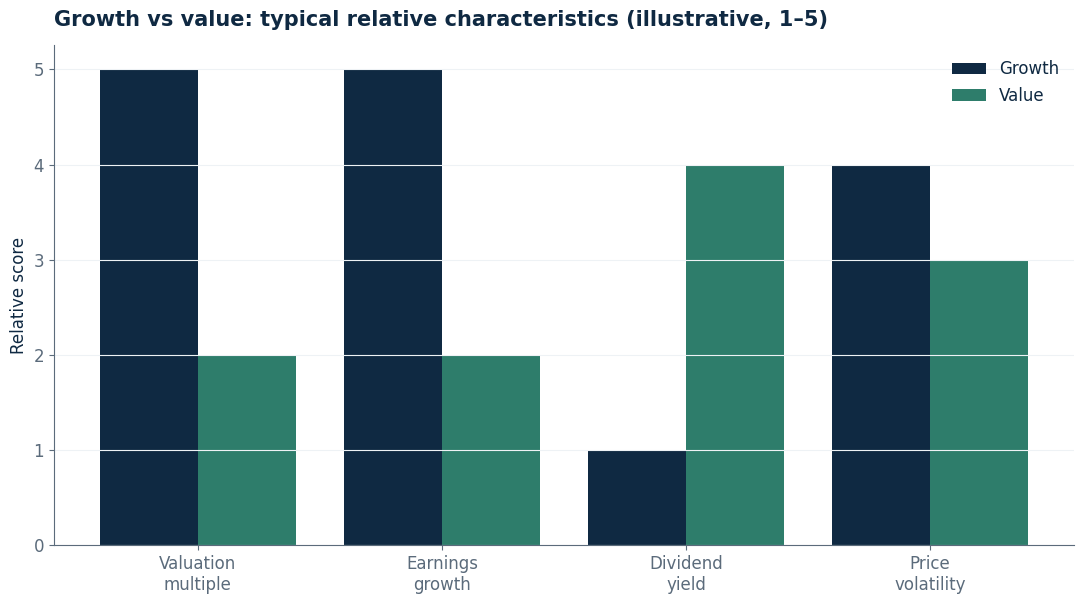
| Feature | Growth investing | Value investing |
|---|---|---|
| Core thesis | The future will be bigger than the present; pay for potential | The present is worth more than the market thinks; pay for proven assets at a discount |
| Typical valuation | High P/E and price-to-sales multiples | Low P/E, often near or below book value |
| What you’re buying | Fast revenue and earnings growth | Underpriced fundamentals, margin of safety |
| Dividends | Usually small or none — cash is reinvested | Often a meaningful dividend yield |
| Classic examples | Cloud, AI, software, innovative biotech | Banks, energy, industrials, out-of-favor retailers |
| Volatility | Higher; swings hard with sentiment and rates | Lower on average; steadier but can stay cheap for years |
| Best environment | Low or falling rates, strong expansion, tech disruption | Rising rates, value rotations, recoveries from a downturn |
| Main risk | Paying up for growth that never arrives | The “value trap” — cheap because the business is broken |
| Temperament it suits | Comfortable with volatility and long holding periods | Patient, contrarian, allergic to overpaying |
If you only remember one row, make it the last one. The right style is the one you can actually hold through a bad stretch without panic-selling at the bottom — and both styles will hand you a bad stretch eventually.
What growth investing actually is
Growth investing focuses on companies expected to grow revenue and earnings significantly faster than the overall market. The catch is the price tag. Growth investors knowingly pay premium valuations — elevated P/E ratios, high price-to-sales multiples — because the bet is that rapid expansion will make today’s “expensive” price look cheap in five or ten years.
Think fast-scaling software companies, the big cloud platforms, AI leaders, and innovative biotech. These businesses tend to plow their cash back into the company rather than pay dividends, which is exactly what you want if the reinvestment keeps compounding at a high rate.
The part people get wrong about “expensive”
A high P/E is not, by itself, a reason to avoid a stock — and a low P/E is not, by itself, a bargain. That sounds obvious written down, but it’s the mistake I see most often. A company growing earnings at a fast clip can absolutely justify a multiple that looks insane on a static screen, because the screen has no idea what next year’s earnings will be. The whole skill of growth investing is judging whether the growth is real and durable. If you want the actual mechanics of doing that, our guide to How to Value Growth Stocks walks through the metrics I lean on, including why a raw P/E tells you almost nothing on its own.
What value investing actually is
Value investing seeks companies the market has underpriced relative to their fundamentals. The value investor goes looking for stocks trading at low P/E ratios, below book value, or at a discount to industry peers, on the theory that markets overreact to bad news and temporary problems. Buy the solid business while it’s out of favor, collect the dividend while you wait, and let the price drift back toward fair value.
Think mature banks, energy companies, industrials, and beaten-down retailers — businesses with real assets and real cash flow that just aren’t exciting right now. Warren Buffett is the patron saint here, and the phrase that defines the discipline is “margin of safety”: pay enough below your estimate of fair value that you’re protected if you’re wrong.
The value trap, and why cheap stays cheap
Here’s the honest risk on this side. A lot of cheap stocks are cheap for a reason — the business is in structural decline, and the low multiple is the market correctly pricing a shrinking future. That’s the “value trap,” and it’s the mirror image of the growth investor overpaying for a story. You buy what looks like a bargain bank or retailer, and three years later it’s still cheap, only now the earnings are lower too. Avoiding traps is to value investing what judging durability is to growth investing: it’s the entire game.
The core philosophical difference
Strip away the ratios and the two camps are making opposite bets about the same thing. Growth investors bet the future will be better than the present, and they pay for potential. Value investors bet the present is already better than the market believes, and they pay for proven assets at a discount.
Both can be right. Both can be wrong. What’s interesting is that they’re wrong for different reasons and at different times — the growth investor gets hurt when rich valuations compress, the value investor gets hurt when “cheap” turns out to be “dying.” That’s why blending them isn’t a cop-out. The two styles fail in different weather.
Historical performance: what the long record says
Over very long horizons, value has a documented edge. Going all the way back to the 1920s in U.S. data, value stocks have historically outpaced growth stocks by a meaningful margin per year — the famous “value premium” that academics have found across multiple countries and decades. It’s one of the more durable findings in finance, and it’s the reason serious people never write value off no matter how unfashionable it gets.
But — and this is a big but — the last couple of decades told a very different story. For most of the recent long stretch, growth crushed value, compounding to dramatically higher cumulative returns and leading in the clear majority of years. If you started investing any time in the past fifteen-odd years, your entire lived experience says growth wins, full stop. Both of those things are true at once, and holding them in your head at the same time is the beginning of investing wisdom here.
I’m deliberately not quoting you precise multi-decade return figures, because the exact numbers depend heavily on the index, the date range, and who’s measuring — and they move every year. The shape of the story is what matters: value wins the very long race on average, growth has dominated the recent era, and the gap between “on average” and “recently” is where most investors get whipsawed.
Style leadership is cyclical, not permanent
The recent cycle is a clinic in how fast this flips. Coming out of 2020, growth ran away from value as the pandemic pulled digital adoption forward by years. Then 2022 happened: interest rates jumped, and rate-sensitive growth valuations got hit far harder than value did. Growth came roaring back through the AI boom of 2023 and 2024, and value has had its own moments of leadership in between.
The lesson I keep relearning: neither style dominates forever, and the investors who get hurt worst are the ones who chase. They pile into growth right at the top because growth “always wins,” then capitulate into value just as the cycle turns back. Performance-chasing across styles is one of the most reliable ways to underperform both of them.
Why growth outperforms in certain environments
Growth stocks aren’t randomly in or out of favor. There’s a logic to when they lead, and understanding it is more useful than memorizing past returns.
Interest rates are the master switch
This is the one to internalize. A growth stock’s value is weighted heavily toward earnings far in the future. When you discount those future earnings back to today, the interest rate you use matters enormously — lower rates make distant earnings worth more right now, higher rates make them worth less. So when rates fall, growth tends to lead; when rates rise sharply, growth usually takes the worst of it. That single mechanism explains a huge share of the 2020-2022 round trip.
Disruption and strong expansions
Growth also shines during waves of technological disruption, when innovative companies are capturing share and inventing entirely new markets — cloud, mobile, and now AI are the obvious recent examples. And it tends to do well during strong economic expansions with stable inflation, when healthy consumer and enterprise spending feeds the top-line acceleration that growth stocks are priced for.
The technology tailwind
A lot of growth’s recent dominance is really one story: the unprecedented scale and speed of digital transformation. The big cloud providers, the AI leaders, and the dominant platform businesses hit growth rates and profit margins that simply weren’t possible at that size in earlier eras. That’s why so much of the modern growth index is concentrated in a handful of mega-cap technology names — which is both the source of the returns and, frankly, the biggest risk sitting inside any growth allocation today.
When value takes the lead
Value’s turn usually comes in conditions that are uncomfortable for growth. Rising or persistently high interest rates favor it, since value’s worth leans on near-term cash flows and assets rather than distant earnings. Recoveries off the bottom of a downturn often favor it too — beaten-up cyclical businesses can snap back hard when the economy reaccelerates. And after a long, lopsided growth run, the sheer valuation gap between the two styles can get so wide that money rotates toward value simply because growth has gotten expensive relative to history.
None of this is a market-timing signal you can trade cleanly. But it’s the reason I’d never run a portfolio with zero value exposure, even in a decade where growth is winning. The hedge is the point.
Growth vs value investing: how I actually choose
So which one is right for you? My genuine answer is “probably some of both, weighted toward how you’re wired and how long you’re investing for.” But if you’re forcing a primary tilt, here’s how I’d think it through.
Match the style to your temperament
Be ruthlessly honest about volatility. Growth will test you — sharp drawdowns, long flat stretches, headlines screaming that the bubble has burst. If a 30%-plus drop in a position would make you sell at the worst possible moment, a heavy growth tilt is fighting your own psychology, and psychology beats strategy every time. Value is steadier day to day, but it demands a different kind of patience: the willingness to hold something boring and out of favor for years while you wait to be proven right. Neither is “easier.” They’re hard in different ways.
Match the style to your time horizon
Time horizon does a lot of the work. The longer your runway, the more comfortably you can carry growth’s volatility, because you have years for the compounding to play out and to ride through the bad cycles. With a short horizon — money you need within a few years — growth’s swings become a real liability, and a steadier, value-leaning or balanced mix tends to fit better. I weight growth more heavily in money I won’t touch for a decade-plus and dial it back in money with a nearer deadline.
Mind the interest-rate regime — but don’t bet the farm on it
Knowing that rates are the master switch is useful for setting expectations, not for jumping in and out. If rates look set to stay high for a long time, I temper my expectations for how easy growth’s ride will be. If they’re falling, growth has a tailwind. But I’ve watched too many people wreck their returns trying to time the style rotation precisely. Tilt gently with the regime; don’t make all-or-nothing bets on it.
You don’t actually have to pick a side
This is the part the “growth vs value” framing obscures, and it’s where I’ve landed personally. The two styles are negatively correlated enough across cycles that owning both smooths your ride considerably. When growth is getting punished by rising rates, value often holds up; when value is dead money in a low-rate boom, growth is carrying the portfolio. You give up the bragging rights of being all-in on the winning style, and in exchange you stop getting whipsawed by the rotation you were never going to time anyway.
How you blend them is a portfolio-construction question, and it depends on your horizon and risk tolerance more than on any forecast. For a structured way to think about that mix — core holdings, satellite positions, and how aggressive to get — our write-up on Growth Stock Investing Strategies That Actually Work is where I’d send you next. The point isn’t to split fifty-fifty out of indecision; it’s to size each style deliberately so that no single regime can take you out of the game.
Funds vs individual stocks
You can express either style with individual names or with funds, and most people are better served leaning on funds for the core. A broad growth index fund hands you the whole style in one ticker with no single-stock blowup risk; a value fund does the same on the other side. If you want the growth sleeve handled cheaply and hands-off, our roundup of the Best Growth ETFs to Buy and Hold in 2026 covers the funds I actually rate and why expense ratio matters more than the clever label on the front. I run a core of funds with a handful of researched individual names around the edges — the fund carries the portfolio, the individual picks add upside without putting the whole thing at risk.
If you do want to pick growth names
Going the individual-stock route on the growth side is the most demanding version of this — real research, real volatility, real chances to be wrong. If that’s the path you want, start from a vetted shortlist rather than a hot tip, and pair it with disciplined position sizing. Our list of the Best Growth Stocks to Buy in 2026 is a sensible place to begin the work, but treat it as a starting universe to research, not a buy list to act on blindly. The names that look obvious today are the ones already priced for perfection.
Common mistakes I see in the growth vs value debate
A few traps come up over and over, and almost all of them are behavioral rather than analytical.
Chasing the recent winner. Backward-looking returns feel like evidence and act like a trap. By the time a style has obviously won for years, you’re buying it expensive and increasing your odds of catching the turn.
Confusing “cheap” with “good” and “expensive” with “bad.” A low multiple on a declining business is a value trap; a high multiple on a genuinely fast grower can be a bargain. The label on the screen is not the verdict.
Believing your own style is the only smart one. Growth investors who sneer at value and value investors who scoff at growth are both ignoring decades of evidence that each one has its season. Tribalism costs money.
Mistaking overlap for diversification. Owning four growth funds that hold the same thirty mega-cap technology names is one bet wearing four tickers, not a diversified portfolio. If you want real diversification, you need genuinely different exposures — which is the whole argument for holding some value.
Frequently asked questions
Is growth or value investing better for beginners?
Honestly, neither in isolation — a blended, fund-based approach is the easiest place for a beginner to start. It spares you from having to call the style cycle correctly and smooths out the ride. If you must lean one way, your time horizon should decide it: a long runway can carry more growth, while money you’ll need soon argues for a steadier, value-leaning or balanced mix.
Why has growth beaten value for so long?
Two big forces. First, a long stretch of low interest rates made growth’s far-off future earnings more valuable today. Second, an extraordinary wave of digital and AI-driven disruption let a handful of mega-cap technology companies grow at a scale that wasn’t previously possible. Both tailwinds favored growth — but rates and disruption cycles change, which is exactly why value’s long-run record still matters.
Can a stock be both growth and value?
Yes, and it happens more than you’d think. The index providers that define these styles often disagree, so a borderline company can be classified as growth by one and value by another, or split between both. A reasonably priced company growing at a healthy clip can legitimately appeal to both camps. The strict either/or framing is cleaner in theory than it is in the actual market.
Does the value premium still work?
This is genuinely debated. The very long historical record shows value outperforming on average, but the recent era flipped the script so hard that some argue the premium has weakened or that the world has structurally changed. My take: I wouldn’t bet everything on the premium reasserting on a schedule, but the long record is strong enough that writing value off entirely looks like recency bias to me. Check current research before drawing firm conclusions.
How do interest rates affect growth vs value?
Rates are the single biggest swing factor. A growth stock’s value sits mostly in distant future earnings, and lower rates make those future earnings worth more today, which lifts growth — while rising rates do the reverse and hit growth hardest. Value, which leans more on near-term cash flows and tangible assets, is less rate-sensitive and often holds up better when rates climb. Confirm the current rate environment, as it shifts.
The Bottom Line
After years of doing this, my real conclusion on growth vs value investing is that the debate is more useful as a lens than as a contest. Value wins the very long race on average; growth has owned the recent era, largely thanks to low rates and a once-in-a-generation technology wave. Neither dominates forever, and trying to time the switch is how most people underperform both. So I don’t pick a permanent winner — I tilt toward growth because of my long horizon and my tolerance for volatility, I keep meaningful value exposure as a hedge against the regime I can’t predict, and I size the whole thing so no single cycle can knock me out. Match the style to your temperament and your time horizon, refuse to chase last year’s winner, and let the compounding do the work.
The practical expression of this debate is usually a rotation between the two styles rather than a permanent allegiance: sector rotation strategy covers how that plays out across the cycle.
Every guide in the Growth vs Value Investing series
Every guide in this cluster goes deeper on one piece of the picture. This is the full set.
- How to Blend Growth and Value Investing for Optimal Returns
- GARP Investing
- Growth Factor Investing
- Growth ETFs vs Value ETFs
- Is Growth Investing Dead? Examining the Case For and Against Growth Stocks
- Peter Lynch’s Stock Picking Strategy
- Quality Growth Investing
- Growth vs Value Stocks Historical Returns
- Style Rotation Strategy
- Warren Buffett and Growth Stocks
- When Value Beats Growth
- Why Growth Stocks Outperform in Low Rate Environments
Last updated: June 2026. Figures are approximate and change — confirm current data before investing. Educational only, not individual investment advice.