
On this page
- Growth stock investing strategies at a glance
- Buy-and-hold compounding: the boring strategy that usually wins
- The CAN SLIM method: growth investing with a checklist
- Momentum: riding strength until it breaks
- GARP: growth without the nosebleed valuation
- Dollar-cost averaging: the strategy you should probably automate
- Building a portfolio: how I actually combine these strategies
- Frequently asked questions
- The Bottom Line
- Every guide in the Growth Strategies & Portfolios series
I’ve been investing in growth stocks for the better part of two decades, and the question I get asked more than any other is some version of “what’s the right way to do this?” My honest answer usually disappoints people, because there isn’t one. There are several. The most effective growth stock investing strategies are the ones that fit your time horizon, your risk tolerance, and how much of your life you actually want to spend watching markets: buy-and-hold compounding, the CAN SLIM checklist, momentum, growth at a reasonable price (GARP), and dollar-cost averaging are the big ones, and most investors blend a few. A patient buy-and-hold compounder and a screen-watching momentum trader can both make money — they just do almost nothing alike. This guide walks through the approaches I’ve used, the trade-offs I’ve learned the hard way, and how to figure out which one fits you.

Before we get into the weeds, a quick word on what ties all of this together. Every strategy here is just a different way of answering the same two questions: which companies do I buy, and when do I sell? If you want the foundations underneath all of it, our deep dive on Growth Stock Investing is the place I’d send a friend who’s just starting out. Everything below assumes you’ve got at least a rough handle on that.
Growth stock investing strategies at a glance
Here’s how I’d compare the major approaches side by side. Treat this as a map, not a ranking — there’s no “winner” column, because the best one genuinely depends on you. The effort and risk labels are my own rough read, and your mileage will vary with how you execute each one.
| Strategy | Core idea | Typical holding period | Effort | Volatility/risk profile | Best suited to |
|---|---|---|---|---|---|
| Buy-and-hold compounding | Own great businesses for years and let earnings growth do the work | Years to decades | Low (after research) | High short-term swings, lower behavioral risk | Patient investors who can sit through drawdowns |
| CAN SLIM | Systematic checklist of earnings, leadership and demand signals | Weeks to months | High | High; relies on disciplined selling | Active investors who like rules and routines |
| Momentum | Buy what’s already strong, sell when strength fades | Days to months | High | High; sharp reversals are common | Rules-driven traders who can cut losses fast |
| GARP (growth at a reasonable price) | Growth, but only at a sane valuation | Months to years | Medium | Moderate; aims to avoid overpaying | Investors who want growth without nosebleed multiples |
| Dollar-cost averaging | Invest a fixed amount on a fixed schedule, regardless of price | Open-ended | Very low | Smooths entry risk; doesn’t remove market risk | Almost everyone, as a default habit |
Most real portfolios I’ve seen — including mine — end up blending two or three of these rather than picking one and swearing off the rest. So read these as ingredients, not religions.
Buy-and-hold compounding: the boring strategy that usually wins
If I had to bet a stranger’s retirement on a single approach, it’d be this one. You buy high-quality growth companies and you hold them for years, sometimes decades, and you let the business do the heavy lifting. The math is what makes it work. If a company can grow its earnings at a strong double-digit clip year after year, the stock price eventually has to follow — even if the valuation multiple shrinks along the way, because business growth tends to overwhelm multiple contraction over long stretches. I’m hedging the exact figures on purpose; the principle holds, the precise numbers never repeat.
The catch is that “boring” is doing a lot of work in that sentence. Buy-and-hold is simple to describe and brutal to actually execute, because the best growth stocks routinely fall 30%, 40%, sometimes 50% or more during corrections, earnings misses, and sector rotations. I’ve held names that cut in half and went on to multiply from there. I’ve also held names that cut in half because the business was quietly falling apart. Telling those two apart is the entire game.
What actually deserves a long-term hold
Not every fast grower earns a permanent spot. The ones I’m willing to hold through the ugly stretches tend to share a few traits: a large enough addressable market that there’s room to grow for years, a real competitive moat (network effects, switching costs, brand, scale), a management team that’s proven it can execute, customers who stick around and spend more over time, and — this is the one people skip — a business model where growth improves the economics instead of constantly demanding fresh capital to stay alive. When most of those boxes are checked, a drawdown is a sale, not a fire alarm.
Figuring out whether you’re paying a fair price for all that quality is its own skill, and frankly it’s where I see beginners get burned the most. A wonderful company bought at a ridiculous valuation can still be a lousy investment for years. If you only read one companion piece to this section, make it our guide on How to Value Growth Stocks — it’ll keep you from confusing a great business with a great stock at any price.
The discipline part
Here’s the uncomfortable truth: the hard part of buy-and-hold isn’t the buying or the holding. It’s not selling when every fiber of you wants to. My rule is to revisit the thesis, not the stock price, when a position is getting hammered. Is the market still big? Is the competitive position still strong? Is management still executing? If the answers are still yes, the drawdown is noise. If one of them flips to no, that’s when I’m actually selling — not because the chart looks scary. Selling on price action alone is how I’ve made some of my worst mistakes, and unlearning that instinct took me years.
The CAN SLIM method: growth investing with a checklist
CAN SLIM is the most structured growth strategy I know of, and if you’re the kind of person who likes a system, you’ll probably love it. It was developed by William O’Neil, the founder of Investor’s Business Daily, after studying what the biggest stock winners had in common before they took off. The name is an acronym for seven things to look for. I’ll be honest up front: this is a high-effort, active approach. It asks you to watch your holdings closely and to sell with discipline. If that sounds exhausting, skip to the next section — no shame in it.
Breaking down the seven letters
Here’s how I think about each one, in plain English:
- C — Current quarterly earnings. You want strong year-over-year EPS growth in the most recent quarter, ideally accelerating. Earnings that are speeding up quarter over quarter are one of the cleaner signals that something good is happening inside the business.
- A — Annual earnings growth. One great quarter can be a fluke. You want a consistent multi-year track record of solid annual EPS growth to back it up.
- N — New. The biggest winners usually have something genuinely new behind them: a breakthrough product, a new management team, a fresh market, or the stock pushing into new highs. Counterintuitively, stocks making new 52-week highs tend to keep making them.
- S — Supply and demand. Watch volume. Rising prices on heavy volume suggest real institutional buying. Smaller share floats can move more dramatically when demand shows up.
- L — Leader or laggard. Buy the leaders in leading industries, not the cheap also-rans hoping to catch up. Laggards rarely do.
- I — Institutional sponsorship. You want to see growing ownership from quality funds — but not a stock that’s so over-owned there’s no one left to buy.
- M — Market direction. This is the one people forget, and it might be the most important. Roughly three out of four stocks follow the broad market, so O’Neil’s whole point is that even a perfect CAN SLIM stock is fighting gravity in a downtrend. Read the market, not just the company.
My take after years of dabbling with it: CAN SLIM’s real value isn’t the acronym, it’s the discipline it forces. It makes you sell laggards, respect the overall trend, and demand actual earnings instead of a good story. Where it bites people is the selling — the system pairs tight buy rules with tight loss-cutting rules, and if you keep the first half and ignore the second, you’ve kept all the risk and thrown away the protection.
Momentum: riding strength until it breaks
Momentum investing is almost philosophically opposed to value investing: instead of buying what’s cheap and out of favor, you buy what’s already strong and getting stronger, on the bet that winners keep winning over the medium term. It overlaps with CAN SLIM’s leadership and relative-strength ideas, but pure momentum strips away most of the fundamental homework and leans on price behavior itself.
I’ll be candid — I keep momentum on a short leash in my own approach. It can work beautifully in trending markets, and it can absolutely shred you when the trend snaps, because the same strength that drew you in reverses hard and fast. The non-negotiable for anyone trading momentum is a predefined exit. You decide where you’re wrong before you buy, and you act on it without negotiating with yourself. Momentum without a sell rule isn’t a strategy, it’s a way to give back gains in a single bad week.
The other thing momentum demands is honest position sizing and a real plan for when you’re wrong. This is where the discipline of Risk Management for Growth Stock Investors stops being optional. The traders I’ve watched survive momentum long-term aren’t the ones with the best entries — they’re the ones who cut losers quickly and never let a single position blow a hole in the account.
GARP: growth without the nosebleed valuation
GARP — growth at a reasonable price — is the middle path, and it’s where a lot of my own thinking has landed over the years. The idea is to hunt for genuine growth, but to refuse to pay any price for it. You still want companies growing faster than the market, but you cross-check that growth against the valuation so you’re not handing over fifty years of future earnings today. A common shorthand in GARP circles is to weigh the valuation against the growth rate, so that a faster grower can justify a richer multiple than a slower one — without the multiple drifting into fantasy.
Why I like it: GARP keeps you in the growth game while building in a margin of safety that pure momentum and even pure buy-and-hold sometimes lack. The trade-off is that you’ll occasionally pass on a screaming winner because it never got cheap enough for your taste, and you’ll watch it run without you. That stings. But over a full cycle, refusing to overpay has saved me from far more pain than it’s cost me in missed upside.
GARP also sits right on the fault line between two whole schools of investing, which is exactly why it’s worth understanding the broader debate. If you’ve ever wondered whether you’re really a growth investor or a closet value investor, our comparison of Growth vs Value Investing maps the spectrum, and GARP lives squarely in the overlap.
Dollar-cost averaging: the strategy you should probably automate
Dollar-cost averaging isn’t a stock-picking method — it’s a buying discipline, and it pairs with every other strategy on this page. You invest a fixed dollar amount on a fixed schedule, no matter what the market’s doing. When prices are down, your money buys more shares; when prices are up, it buys fewer. Over time that mechanically lowers your average cost and, more importantly, it takes the single hardest decision — when to buy — off your plate entirely.
I think the underrated benefit here is behavioral, not mathematical. Trying to time your entries into volatile growth names is a fast track to buying at the top out of excitement and freezing at the bottom out of fear. Automating your contributions removes that emotional whipsaw. It won’t shield you from a market that keeps falling — nothing does — but it keeps you investing through the scary stretches, which is exactly when the best long-term buys tend to happen. For most people, the right move is to set up automatic contributions and then mostly leave them alone.
Building a portfolio: how I actually combine these strategies
Here’s where it all comes together, because in practice nobody runs a single strategy in a vacuum. The structure I keep coming back to is core-and-satellite. You build a stable, diversified core that does most of the work, and you surround it with a smaller number of higher-conviction, higher-risk satellite positions where you’re trying to add extra return. The core is where buy-and-hold and dollar-cost averaging live; the satellites are where a momentum trade or a single-stock bet can earn its keep without putting the whole portfolio at risk.
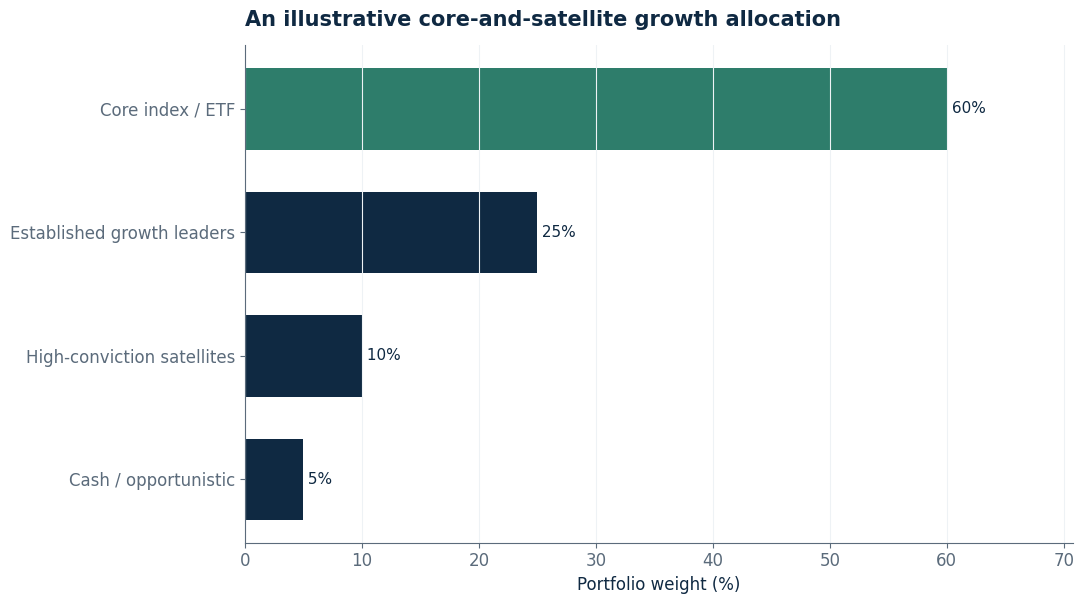
The chart above is illustrative, not a prescription — the right split depends entirely on your age, goals, and stomach for volatility. But the principle is what matters: the core should be large enough and diversified enough that no single satellite blowing up can derail your plan. I keep satellites small on purpose. A position you can’t afford to lose has no business being a high-risk bet.
The biggest portfolio mistake I see growth investors make isn’t picking the wrong strategy — it’s not sizing positions to the risk they actually carry. A speculative momentum name and a blue-chip compounder should not be the same size in your account, full stop. This is why I treat position sizing and exit rules as part of the strategy itself, not an afterthought, and why I’d push anyone building a real portfolio to internalize solid risk management habits before they ever worry about which clever screen to run.
Matching the strategy to your life, not the other way around
The single most useful thing I can tell you is to pick the strategy you can actually stick with through a bad year — because every one of these has bad years. A momentum system you abandon the first time it whipsaws you is worse than a buy-and-hold plan you’ll calmly hold through a 40% drawdown. Be honest about your temperament and your available time. If you can’t watch positions daily, don’t build a strategy that requires it. If you panic-sell at the bottom, lean harder on automation and diversification so fewer decisions land on you in the moment.
Frequently asked questions
What is the best growth stock investing strategy for beginners?
For most beginners I’d start with buy-and-hold compounding paired with dollar-cost averaging. You buy high-quality growth companies (or a broad growth fund) and contribute on a regular schedule. It demands the least ongoing decision-making, which is exactly what protects new investors from their own worst impulses in a volatile market.
Is momentum trading a good strategy for growth stocks?
It can work, but only with strict discipline. Momentum buys strength and sells weakness, so it’s high-effort and unforgiving when trends reverse. If you can’t define your exit before you buy and act on it without hesitation, momentum will likely cost you more than it makes. It suits rules-driven traders, not casual investors.
How is CAN SLIM different from buy-and-hold?
Buy-and-hold focuses on owning great businesses for years and ignoring short-term noise. CAN SLIM is an active checklist combining earnings strength, market leadership, institutional demand, and overall market direction, with much shorter holding periods and disciplined selling. One rewards patience; the other rewards routine and quick loss-cutting. Many investors borrow ideas from both.
Can I combine more than one growth strategy?
Absolutely, and most experienced investors do. A common setup is a core-and-satellite structure: buy-and-hold compounders funded by dollar-cost averaging form the core, while momentum trades or single high-conviction picks sit as smaller satellites. The key is sizing the riskier satellite positions modestly so no single bet can derail the whole portfolio.
Which strategy has the highest returns?
There’s no honest universal answer, and I’d be wary of anyone who gives you one. Returns depend on execution, time horizon, and market conditions far more than the label. An aggressive momentum approach can outperform in a strong trend and badly underperform when it reverses. The strategy you’ll actually stick with usually beats the “best” one you’ll abandon.
The Bottom Line
After all these years, my conviction is simple: the best growth stock investing strategy is the one that fits how you’re actually wired. Buy-and-hold rewards patience, CAN SLIM and momentum reward discipline and active work, GARP keeps you from overpaying, and dollar-cost averaging quietly makes every other approach easier to live with. Most strong portfolios blend two or three inside a core-and-satellite frame, size each position to its real risk, and decide where to sell before they ever buy. Pick the approach you can hold through a bad year, and let the businesses compound. If you want concrete names to apply all this to, our list of the Best Growth Stocks to Buy in 2026 is a sensible next stop.
Every guide in the Growth Strategies & Portfolios series
Every guide in this cluster goes deeper on one piece of the picture. This is the full set.
- How to Build a Growth Stock Portfolio
- Buy and Hold Investing for Growth Stocks
- CANSLIM Strategy
- Coffee Can Investing
- Concentrated vs Diversified Portfolios
- Dollar Cost Averaging for Growth Stocks
- Momentum Investing Strategy for Growth Stocks
- Portfolio Rebalancing Strategy
- Position Sizing Strategy
- Sector Rotation Strategy
- Swing Trading Growth Stocks
- When to Take Profits on Growth Stocks
- Tax Loss Harvesting Strategy
Last updated: June 2026. Figures are approximate and change — confirm current data before investing. Educational only, not individual investment advice.