

On this page
- Why growth investors need risk management more than anyone
- The main risks, and how I actually manage each one
- Position sizing: your first and best line of defense
- Stop-loss strategies for growth stocks
- Diversification without diworsification
- Managing the psychology — the risk you can’t put in a spreadsheet
- Putting growth stock risk management into a single routine
- Frequently asked questions
- The Bottom Line
- Every guide in the Risk Management & Psychology series
I’ve owned growth stocks long enough to have lived through the gut-punch quarters — the kind where a name you researched for weeks drops 40% overnight on an earnings miss that, on paper, barely moved the numbers. Early on I thought the job was picking winners. It isn’t. The job is making sure no single loss can end your run. Growth stock risk management is the set of habits — position sizing, stop-losses, diversification, and a written plan — that lets you stay in the game through the drawdowns that growth investing guarantees, so your best ideas have time to compound instead of getting wiped out by your worst one. That’s the whole ballgame, and it’s what this guide is about.

Here’s the math that reframed everything for me. A 50% drawdown doesn’t need a 50% gain to recover — it needs a 100% gain. Lose half, and you have to double what’s left just to break even. A 30% loss needs about a 43% rebound. A 20% loss needs 25%. Losses compound against you harder than gains compound for you, and that asymmetry is the single best argument for taking risk seriously before you ever think about returns.
Why growth investors need risk management more than anyone
Growth stocks are wired to be volatile. When a company trades at 40x or 60x earnings, the price has baked in years of flawless execution. Miss those expectations even slightly and the market reprices fast and brutally. A value stock at 10x earnings might shrug off a bad quarter with a 15% dip. A growth stock at 60x can shed 40% to 50% on the same magnitude of disappointment. Same news, wildly different damage.
I’m not telling you this to scare you off growth — I invest here on purpose because the upside is real. But you have to go in clear-eyed. Drawdowns are more frequent and deeper in this corner of the market, and the goal was never to dodge every loss. That’s impossible. The goal is to make sure no single loss, and no ugly cluster of them, does permanent damage. If you’re new to the style, our Growth Stock Investing guide lays the foundation; this article is about surviving long enough to enjoy it.
The main risks, and how I actually manage each one
Before the tactics, it helps to name what you’re defending against. Risk in growth investing isn’t one thing — it’s several, and each has its own countermeasure. Here’s how I map them.
| Risk type | What it looks like | How I manage it |
|---|---|---|
| Single-stock blowup | One holding craters 40-60% on an earnings miss, fraud, or failed product | Position sizing — cap any one name so a disaster dents but doesn’t sink the portfolio |
| Concentration risk | Several holdings are really the same bet (e.g., five AI names that move together) | Diversify across sectors and themes; check correlation, not just the number of tickers |
| Valuation / multiple compression | Great company, but the whole growth style derates as rates rise or sentiment turns | Mind entry valuation; size richer-priced names smaller; expect style-wide drawdowns |
| Drawdown / open-loss risk | A position keeps bleeding and you keep “giving it room” | Pre-set stop-loss or sell rule decided before you buy, not in the heat of the moment |
| Liquidity risk | Thin small-caps gap down with no buyers; you can’t exit at a fair price | Smaller positions in illiquid names; use limit orders; avoid micro-floats you can’t escape |
| Behavioral risk | Fear, FOMO, anchoring to your cost basis, refusing to sell a loser | A written plan you follow mechanically — the rules exist to overrule the emotions |
Notice the pattern: almost every fix is decided in advance and applied with discipline. The market doesn’t reward improvisation when a stock is down 30% and your stomach is in your throat. The work happens before the trade.
Position sizing: your first and best line of defense
If you make me pick the most important risk tool, it’s not stop-losses and it’s not diversification — it’s position sizing. How much of your portfolio you put into each stock determines, more than anything else, whether a great pick actually moves your wealth and whether a bad one can ruin you. Get sizing wrong and even a brilliant watchlist produces mediocre or catastrophic results.
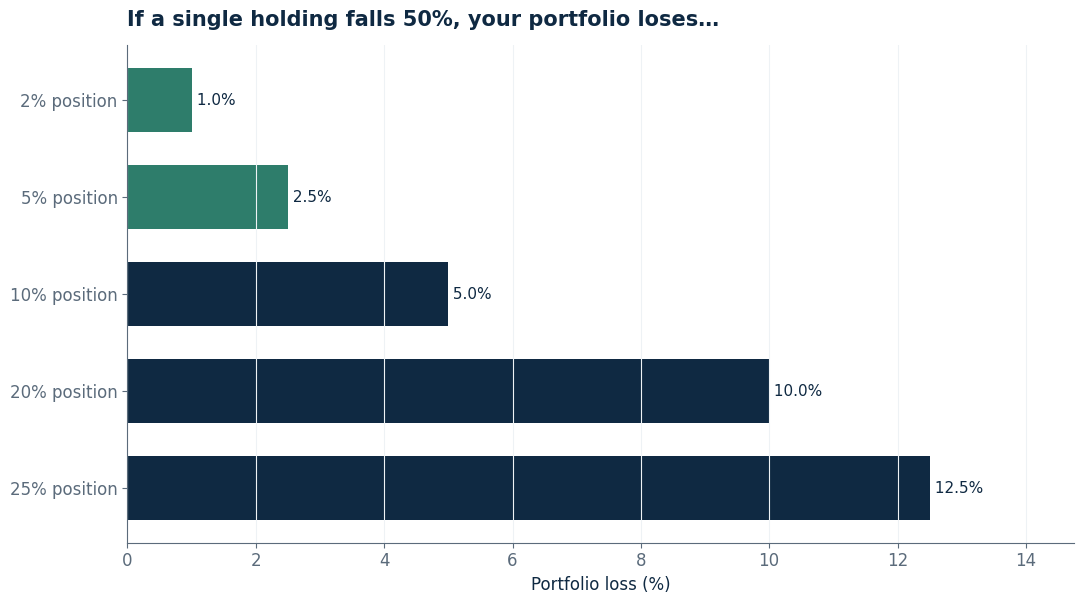
The chart above is the math I wish someone had drilled into me on day one. Take a single stock falling 50% — a totally ordinary event in growth investing — and watch what it does to your whole portfolio at different position sizes. At a 5% position, that 50% crash costs you 2.5% of your portfolio. Annoying, survivable, forgettable within a quarter. Bump that same stock to a 20% position and the identical 50% drop now carves 10% off your total. Push it to 40% — the kind of “I’m so sure about this one” bet I’ve seen wreck people — and a single 50% decline torches 20% of everything you own, from one name being wrong.
That’s the entire case for sizing, in one picture. The stock’s behavior is identical in every scenario. The only thing that changed is how much you let it matter. Risk management is largely the discipline of refusing to let any one stock matter too much.
The percentage-of-portfolio method
The simplest framework, and the one I lean on most, is capping each position as a fixed slice of total portfolio value. For growth stocks, a structure I’m comfortable using looks roughly like this:
- Start new positions at around 2-4% of the portfolio.
- Let high-conviction winners grow to 5-8% through appreciation — earn the size, don’t buy it all up front.
- Set a hard ceiling of about 10-15% for any single name, no matter how in love with it you are.
- Trim back toward target when a position blows past your comfort line.
This keeps you diversified enough to survive any one company imploding, yet concentrated enough that your best ideas genuinely move the needle. Honestly, the hardest part isn’t the math — it’s trimming a winner. It feels like betraying your own thesis. But letting one position balloon to 25% of the book because it’s been right is how a great year quietly turns into a fragile one.
The risk-per-trade method
More active investors size by how much they’re willing to lose if a trade goes against them, rather than by raw dollar allocation. The common rule is risking no more than 1-2% of total portfolio value on any single position. Say your portfolio is $100,000 and you cap risk at 1% per trade — you’ve decided in advance you can stomach losing $1,000 on any one name.
How that converts to position size depends on your stop distance. With a 10% stop-loss, a $1,000 risk budget supports a $10,000 position, because a 10% drop on $10,000 is exactly your $1,000 limit. Widen the stop to 20% and that same $1,000 budget only allows a $5,000 position. I like this method precisely because it does the right thing automatically: the more volatile and the wider the stop you need, the smaller the position it hands you. That’s risk management baked into the arithmetic.
Adjusting size for volatility
Not every growth stock carries the same risk, so I don’t size them the same. A profitable large-cap with a long record of beating earnings is a different animal from a pre-revenue biotech betting everything on one trial. The shakier the business, the smaller the position. The proven compounder can justify more.
What I’m really aiming for is roughly equal risk contribution from each holding, not equal dollar amounts. A wild small-cap and a steady mega-cap shouldn’t get the same allocation just because they’re both “one position.” Knowing what a name is actually worth feeds straight into this — our guide on How to Value Growth Stocks covers the valuation work that tells you which bets deserve real size and which deserve a toe in the water.
Stop-loss strategies for growth stocks
A stop-loss is just a price you decide in advance at which you’ll sell to cap the damage. Its real purpose isn’t to protect a single trade — it’s to protect the portfolio and, frankly, to protect you from yourself. When a stock is sliding, every instinct tells you to wait for the bounce. A pre-set sell rule overrules that instinct before it can cost you.
Fixed percentage stops
The classic approach: sell any stock that falls a set percentage below your buy price, often in the 7-10% range. William O’Neil, who developed the CANSLIM method, famously preached a strict 7-8% stop with no exceptions. The logic holds up — if you cap every loss near 8% and let winners run to 20%, 50%, or more, you can be wrong on most of your picks and still come out ahead, because the math of small losses and large gains does the heavy lifting.
I’ll be candid about where fixed stops get tricky with growth stocks, though. These names are so volatile that a routine 8% wiggle can stop you out of a stock that promptly rips higher without you — death by a thousand whipsaws. That’s the real tension: tight stops protect capital but can shake you out of good positions; loose stops give a thesis room but let losses run deeper. There’s no setting that’s right for everyone, and anyone selling you a magic number is overselling.
Mental stops vs hard stops
You can place a hard stop order at your broker so the sale triggers automatically, or run a “mental stop” where you commit to selling if the price closes below your level. Hard stops enforce discipline and protect you if you’re not watching — their weakness is intraday spikes and gaps that fill your order at an ugly price. Mental stops avoid that but only work if you’re honest enough to actually pull the trigger. Plenty of investors set a mental stop, watch it break, and talk themselves into “just one more day.” If that sounds like you, use hard stops. Know thyself.
Stops based on the chart, not your cost
One shift that helped me: setting stops based on the stock’s own structure — a support level, a moving average, a recent swing low — rather than an arbitrary percentage off what I happened to pay. The market doesn’t know or care about your cost basis. A stop placed just under a level that actually matters technically tends to get hit only when the thesis is genuinely breaking, not on routine noise. It’s a more thoughtful way to give a position room while still drawing a hard line.
Diversification without diworsification
Diversification is the free lunch of investing, but in growth it’s easy to fake. I’ve watched people own twelve stocks, feel diversified, and not realize that eight of them were the same bet — all riding the identical AI, cloud, or semiconductor wave, all destined to fall together the day that theme corrects. Counting tickers is not diversification. Spreading across things that don’t all move in lockstep is.
So I think in themes and sectors, not just names. How much of the book rides on enterprise software? On consumer internet? On anything rate-sensitive? When one theme dominates, you don’t really own a portfolio — you own a leveraged bet wearing a portfolio’s clothing. That said, the opposite failure is just as real: spread yourself across fifty names and you’ve built a closet index fund with extra homework and no edge. The sweet spot for most growth investors who pick individual stocks tends to land somewhere in the range of 15 to 30 holdings — enough to absorb a blowup, few enough to actually know what you own.
Position size and diversification work as a pair. Smaller positions in your riskier, more speculative names; larger ones in proven compounders. If you want to put real research behind the riskier sleeve instead of guessing, our roundup of the Best Small Cap Growth Stocks to Buy Now is a sensible place to look — just remember that smaller companies demand smaller positions, because the volatility cuts both ways.
Managing the psychology — the risk you can’t put in a spreadsheet
I can hand you every formula in this article and you’ll still lose money if you can’t manage yourself. The hardest risk in growth investing isn’t in the stocks. It’s in the mirror.
Three behaviors do most of the damage, and I’ve fallen for all of them. Refusing to sell a loser because selling makes the loss “real” — so you hold a deteriorating stock, hope replaces analysis, and a manageable 10% loss becomes a portfolio-denting 40%. Chasing winners on FOMO, piling into a name that’s already run hard, with no plan and no edge, right before it cools off. And anchoring to your cost basis, making decisions around what you paid instead of what the company is worth now — the stock doesn’t know your entry, and it owes you nothing.
The antidote to all of it is the same: a written plan made when you’re calm, followed when you’re not. Before I buy, I write down why I own it, what would prove me wrong, and where I’ll sell. When the position moves, I’m executing a decision my rational self already made, not improvising while adrenaline runs the show. That single habit has saved me more money than any stock pick. The rules exist precisely for the moments your judgment is compromised.
Putting growth stock risk management into a single routine
None of these tools works in isolation — they reinforce each other. Here’s how I actually run the system, start to finish:
Before buying, I size the position by conviction and volatility, decide where the stop or sell rule sits, and write a one-paragraph thesis with the conditions that would change my mind. While holding, I keep an eye on whether any single name or theme has crept past my comfort line, and I trim winners that have grown too large rather than letting them dictate the portfolio’s fate. When something breaks, I follow the plan I wrote when I was calm — I take the loss at my predetermined level instead of negotiating with a falling stock. Periodically, I zoom out and check the whole book: Is it too concentrated? Too scattered? Is the overall risk level something I can sleep with through a 20% market drawdown, because those come around more often than anyone likes to admit?
That loop — plan, size, monitor, act, review — is the entire discipline. It’s not glamorous and it won’t impress anyone at a dinner party, but it’s what separates investors who are still standing after a brutal year from those who aren’t. If you want to see how these defenses slot into specific approaches, our breakdown of Growth Stock Investing Strategies That Actually Work shows the playbooks in action, and the current Best Growth Stocks to Buy in 2026 list gives you names to apply this framework to — emphasis on apply the framework, not just buy the list.
Frequently asked questions
What is the most important risk management tool for growth stocks?
Position sizing, hands down. It decides how much any single stock can hurt you, and as the chart shows, the same 50% drop is trivial at a small position and devastating at a large one. Stops and diversification matter, but sizing is the foundation everything else sits on.
What percentage stop-loss should I use on growth stocks?
Many investors use a 7-10% stop, and O’Neil’s CANSLIM method favors a strict 7-8% rule. The catch is that volatile growth stocks can whipsaw you out of good positions. Some traders prefer stops set just below technical support instead of a fixed percentage. There’s no universal number — match it to the stock’s volatility.
How many growth stocks should I own to be diversified?
For investors picking individual names, somewhere around 15 to 30 holdings tends to balance things well — enough to survive a single-stock blowup, few enough to track properly. What matters more than the count is whether your holdings move independently. Twelve names riding the same theme aren’t really diversified.
How do I recover from a big drawdown in growth stocks?
Recovery math is unforgiving: a 50% loss needs a 100% gain to break even. The honest answer is that prevention beats cure — disciplined sizing and stops keep losses survivable in the first place. If you’re already deep in a hole, resist doubling down on hope; reassess each holding on its current merits, not your cost.
Are stop-losses always a good idea for growth investing?
Not automatically. Hard stops protect you from catastrophe and emotion, but growth stocks are volatile enough that tight stops can shake you out before a thesis plays out. The alternatives are wider stops, technical stops, or smaller positions with more room. Pick the approach that matches how much volatility the position can reasonably throw at you.
The Bottom Line
After years of doing this, my take is simple: in growth investing, you don’t control the returns, but you do control the risk — and that’s the lever that actually decides your fate. Size positions so no single name can sink you. Set your sell rule before you buy, not while you’re panicking. Diversify across things that don’t all move together, and write a plan you’ll follow when your emotions are screaming at you to break it. Do that, and you give your best ideas the years they need to compound, while making sure your worst idea is just a bad week — not the end of the story. Master the defense, and the offense takes care of itself.
Three of the practical mechanisms I lean on most have their own guides: position sizing strategy, which decides how much damage any one mistake can do; when to take profits, which is where most of the emotional difficulty lives; and portfolio rebalancing, the unglamorous habit that keeps a winner from quietly becoming your whole portfolio.
Every guide in the Risk Management & Psychology series
Every guide in this cluster goes deeper on one piece of the picture. This is the full set.
- Averaging Down on Stocks
- Bear Market Survival Guide for Growth Investors
- Stock Market Bubble Signs
- Stock Correlation Analysis
- Diversification Strategy for Growth Investors
- Portfolio Drawdown Management
- Emotional Discipline in Investing
- How to Handle Stock Market Volatility
- Hedging Stock Positions
- Common Investing Mistakes
- Stop-Loss Strategies for Growth Stocks
- When to Sell Stocks
Last updated: June 2026. Figures are approximate and change — confirm current data before investing. Educational only, not individual investment advice.



1 comment