
On this page
- Why healthcare is a premier growth sector
- The healthcare growth sub-sectors at a glance
- GLP-1 and obesity: the biggest growth story in pharma
- Biotech: the highest highs and lowest lows
- Gene and cell therapy: from managing disease to curing it
- Medical devices: the steady compounder of healthcare
- Telehealth and digital health: huge promise, messy reality
- AI in healthcare: the theme bending the whole sector
- Large pharma: growth and a paycheck
- The innovation engine: why FDA approvals matter to your returns
- Healthcare REITs: the landlord’s angle on aging
- How I actually evaluate a healthcare growth stock
- Frequently asked questions
- The Bottom Line
- The complete healthcare and biotech growth series
I came to healthcare investing the long way around. For years I treated it as the boring “defensive” sleeve of my portfolio — the stuff you own so your spouse doesn’t worry — while I chased the exciting growth elsewhere. Then a few things happened at once: a weight-loss drug rewrote the obesity market overnight, gene therapies started actually curing diseases instead of just managing them, and AI began shrinking drug-discovery timelines. I looked up and realized some of the fastest-growing businesses on any exchange were sitting in a sector I’d written off as sleepy. So let me give you the short version up front. The best healthcare growth stocks cluster in a handful of sub-sectors — biotech, gene and cell therapy, medical devices, telehealth and digital health, large pharma, and the GLP-1 obesity drugs — where scientific breakthroughs, an aging population, and rising spending let the winners compound for years. The catch, and it’s a big one, is that healthcare hides more land mines than almost any sector I invest in.

Here’s the thing people miss. “Healthcare stock” tells you almost nothing on its own. A clinical-stage biotech with no revenue and one drug in trials, a surgical-robot maker with fat recurring margins, and a 100-year-old pharma giant paying a dividend are all “healthcare,” and they behave like completely different animals. One can triple or go to zero on a single trial readout; another grinds out steady mid-teens growth for a decade. So I’m going to break the sector down the way I actually think about it — by sub-sector — and point you to a deeper guide for each piece as we go. My goal is that by the end you can look at any healthcare name and roughly place it: what drives it, what could break it, and whether it belongs in a growth portfolio at all.
Why healthcare is a premier growth sector
Healthcare spending runs around 18% of U.S. GDP — check the current figure, it creeps up most years — and it keeps growing faster than the overall economy. That’s not an accident, and it’s not going to reverse. A few structural forces make this a durable growth story rather than a passing theme.
The first is demographics, and it’s the one I trust most because you can practically see it coming. The global population aged 65 and older is on track to roughly double by 2050. Older people need more medications, more procedures, more devices, more care. That’s a demand curve you can lean on for decades, not quarters. It’s about as close to a sure thing as investing offers.
The second is the science, and this is the part that turned me from skeptic to believer. We are living through a genuine golden age of biology. GLP-1 drugs for obesity, gene therapies that fix the underlying defect behind inherited diseases, AI-accelerated drug discovery — each of these is a multi-billion-dollar market that essentially did not exist a decade ago. New treatment categories are being invented, not just incrementally improved.
The third reason is the one that lets me sleep: healthcare spending is stubbornly recession-resistant. People need their insulin, their cancer treatment, their hip replacement regardless of what the economy is doing. That gives the sector a defensive floor that pure tech plays simply don’t have. My honest take is that this combination — explosive innovation on top of recession-resistant demand — is rarer than it sounds, and it’s why I now treat healthcare as a core growth allocation rather than ballast. If you’re building the broader portfolio around it, I’d read this alongside my guide to the best growth stocks to buy in 2026, where healthcare names earn a real seat at the table next to tech.
The healthcare growth sub-sectors at a glance
Before we go deep, here’s the map I keep in my head. This table lays out the major healthcare growth sub-sectors, what actually drives each one, and the kind of risk that tends to bite. Treat it as a starting frame, not gospel — the lines blur constantly, and plenty of companies straddle two or three of these.
| Sub-sector | What drives it | Representative names | Main risk to watch |
|---|---|---|---|
| GLP-1 / obesity drugs | Massive untreated patient pool; expanding insurance coverage | Eli Lilly (LLY), Novo Nordisk (NVO) | Sky-high expectations; new competition |
| Biotech | Clinical trial success; FDA approvals; M&A | Vertex (VRTX), Regeneron (REGN), Amgen (AMGN) | Binary trial outcomes; cash burn |
| Gene & cell therapy | One-time curative treatments; platform technologies | CRISPR Therapeutics (CRSP), Intellia (NTLA) | Early-stage science; pricing and access |
| Medical devices | Aging demographics; recurring consumables; procedure volume | Intuitive Surgical (ISRG), Boston Scientific (BSX) | Slow product cycles; reimbursement |
| Telehealth / digital health | Care moving online; software economics in healthcare | Teladoc (TDOC), digital-health platforms | Crowded field; thin or negative margins |
| Large pharma | Diversified pipelines; dividends; scale | Eli Lilly (LLY), Merck (MRK), AbbVie (ABBV) | Patent cliffs; pricing pressure |
| Personalized medicine | Genomics, diagnostics, targeted therapies | Diagnostics and genomics leaders | Long commercialization timelines |
| AI in healthcare | Faster drug discovery; diagnostic imaging; admin automation | AI-drug-discovery and imaging players | Unproven economics; long validation |
| Healthcare REITs | Demographic demand for medical real estate; income | Welltower (WELL), Ventas (VTR) | Interest-rate sensitivity; tenant health |
Notice that some names show up in more than one row. Eli Lilly is GLP-1 and large pharma at once. That overlap is exactly why the biggest, most diversified players have been so hard to bet against — they sit at the intersection of multiple tailwinds. Now let’s take the sub-sectors one at a time.
GLP-1 and obesity: the biggest growth story in pharma
If you want to understand why I stopped calling healthcare boring, start here. The arrival of GLP-1 receptor agonists — drugs first developed for type 2 diabetes that turned out to drive dramatic weight loss — has created what a lot of people consider the largest pharmaceutical growth opportunity since statins. I don’t think that’s hype. The numbers behind it are genuinely staggering.
Consider the math. Something like 2.5 billion people worldwide are classified as overweight or obese, and yet only a low single-digit percentage are currently being treated with these medications. As insurance coverage broadens and next-generation oral versions make treatment as simple as swallowing a pill, that treated share has enormous room to grow. Analysts have floated figures north of $100 billion in annual obesity-drug sales by 2030 — from essentially zero a few years ago. Treat that specific number as a directional guess and check current estimates, but the shape of the curve is what matters, and the shape is extraordinary.
Two companies own this story today. Eli Lilly (LLY) has vaulted to the front with tirzepatide, sold as Mounjaro for diabetes and Zepbound for obesity, and its pipeline of next-generation candidates — including oral and multi-target drugs — could widen the lead. Novo Nordisk (NVO) pioneered the category with semaglutide, sold as Ozempic and Wegovy, and remains the formidable incumbent. My honest take: this is a near-duopoly with a colossal runway, but the valuations already price in a lot of that future, and a wave of competitors is racing to enter. That tension — spectacular growth versus expectations baked sky-high — is the whole game with these names. I dig into the players, the pipeline, and the risks in my full breakdown of GLP-1 stocks, and I’d read it before buying either leader.
Biotech: the highest highs and lowest lows
Biotech is where I’ve made some of my best returns and my most painful mistakes, often in the same year. This is the engine room of medical innovation — companies developing the actual drugs and therapies — and the range of outcomes is wider than anywhere else in healthcare. A single positive trial readout can double a stock overnight. A failure can vaporize most of its value by lunch. There’s no sugarcoating that.
I think of biotech as a barbell. On one end sit the profitable, large-cap names — companies like Vertex (VRTX), Regeneron (REGN), and Amgen (AMGN) — that already have approved drugs throwing off real cash and funding the next wave of research. These behave almost like specialty pharma and let you sleep at night. On the other end sit the clinical-stage small caps with no revenue, burning cash, living or dying on trial data. The upside there is life-changing; so is the downside.
The number that matters more than anything in this sub-sector is the pipeline — what’s in development, what phase it’s in, and how big the market would be if it works. Getting that valuation right is genuinely hard, because you’re pricing science that hasn’t happened yet. I walk through how I actually do it in my guide to drug pipeline valuation, which is the single most useful skill I’ve picked up in this corner of the market. For the broader landscape and the specific names I rate, start with my overview of biotech as a whole and where I’d fish for winners.
Clinical trials: where biotech stocks actually move
If you own biotech, you are, whether you like it or not, betting on clinical trials. The three-phase FDA process — Phase 1 for safety, Phase 2 for early efficacy, Phase 3 for the big confirmatory test — is the calendar that drives these stocks, and the readout dates are the events that make or break a position. I’ve learned the hard way to know exactly when a company’s catalysts are coming before I size anything.
The trap newer investors fall into is treating a trial as a coin flip. It isn’t. Different phases carry very different odds, different diseases have wildly different success rates, and the design of the trial itself tells you a lot about management’s confidence. I size trial-dependent positions small and accept that some will go to zero — that’s the cost of admission for the ones that multiply. If you want to trade or invest around these catalysts intelligently, my deep dive on clinical trial stocks lays out how I read the calendar and manage the binary risk.
Biotech IPOs: exciting, and usually overpriced
Biotech is one of the most active corners of the IPO market, and I get the appeal — a fresh story, cutting-edge science, the chance to get in early. But I’ll be candid: most biotech IPOs are too speculative and too richly priced for me to chase on day one. Many come public with a single drug in mid-stage trials and a valuation that already assumes it works. That’s a lot of faith to pay full price for.
My approach is patience. I’d rather let a newly public biotech report a few quarters, watch how management handles the spotlight, and see real trial data before committing, even if it means missing the first pop. The ones worth owning are usually still worth owning six months later at a saner price. If you’re drawn to the new-issue side of the sector, read my take on biotech IPO stocks first — it’ll save you from a few of the mistakes I made paying up for hype.
Gene and cell therapy: from managing disease to curing it
This is the sub-sector that genuinely gives me chills, and I don’t say that about many things in finance. Gene and cell therapies don’t just treat symptoms — they aim to fix the underlying genetic defect, sometimes with a single one-time treatment. We are watching companies turn previously incurable inherited diseases into something approaching a cure. As a piece of science, it’s the most exciting thing happening in medicine.
As an investment, it’s earlier and rougher than the headlines suggest. Companies using gene-editing platforms — names like CRISPR Therapeutics (CRSP) and Intellia (NTLA) — are working with technology that’s still maturing, and the path from a stunning trial result to a profitable, widely used product runs through brutal questions about manufacturing, pricing, and patient access. A one-time cure priced at seven figures raises real questions about who pays and how. The science can be a triumph and the stock still a poor investment if the commercial model doesn’t come together.
My honest positioning: I treat gene therapy as a high-conviction satellite, not a core holding. I want exposure to the platforms that could redefine medicine, but I size the positions knowing the timelines are long and the volatility is severe. Closely related is the broader move toward tailoring treatment to the individual patient’s biology, which I cover in my guide to personalized medicine stocks — genomics, diagnostics, and targeted therapies are the connective tissue between today’s drugs and tomorrow’s cures.
Medical devices: the steady compounder of healthcare
If biotech is the adrenaline of the sector, medical devices are the slow, dependable heartbeat — and honestly, this is where I’d point someone who wants healthcare growth without the nightly heart palpitations. Device makers build the physical tools of modern medicine: surgical robots, heart valves, insulin pumps, imaging systems, implants. The growth is steadier and the businesses are more predictable than drug developers because they don’t live and die on a single trial.
What I love about the best device companies is the razor-and-blade economics. Sell a surgical-robotics system once, and then sell the disposable instruments and service contracts that go with it for years. Intuitive Surgical (ISRG) is the textbook case — its installed base of da Vinci systems generates high-margin recurring revenue every time a procedure is performed, which is exactly the kind of annuity I want underneath a growth holding. Broader players like Boston Scientific (BSX) ride the same demographic wave across a diversified product line.
The risks here are real but slower-moving. Product cycles are long, regulatory clearance takes time, and reimbursement decisions by insurers and Medicare can make or break a new device’s economics. My take is that devices deserve a meaningful, stabilizing place in a healthcare sleeve — they give you the aging-population tailwind with far less binary risk than the drug side. There’s also heavy overlap with robotics and automation, which I cover from the tech angle in my guide to the best technology growth stocks, since the line between a medical device and a robot keeps getting blurrier.
Telehealth and digital health: huge promise, messy reality
I want to be straight with you about this one, because I think a lot of investors got burned here and the lesson is worth keeping. Digital health — telehealth visits, remote monitoring, health apps, software that runs hospitals — has an enormous and genuine long-term tailwind. Care is moving online, and software economics applied to healthcare’s vast inefficiency should, in theory, create big winners.
In practice, it’s been brutal. The pandemic pulled forward years of telehealth demand, valuations went vertical, and then reality set in: the market is crowded, customer acquisition is expensive, and a lot of these businesses have struggled to turn growth into actual profit. Teladoc (TDOC) became the cautionary tale of the whole theme — a real business that the market repriced savagely once the hype faded. I’m not writing the sub-sector off; I think the durable winners will be the platforms with sticky software embedded in hospital and insurer workflows, not the standalone apps fighting for attention.
My honest take: digital health is the sub-sector where I’m pickiest and least willing to pay up on a story alone. I want to see a path to real margins, not just user growth. The most interesting evolution here is the marriage of digital health with artificial intelligence — AI-driven diagnostics, imaging, and administrative automation are where I think the next real value gets created, and I cover those specifically in my guide to AI healthcare stocks.
AI in healthcare: the theme bending the whole sector
Speaking of which — if there’s one cross-cutting force reshaping every sub-sector on this page, it’s artificial intelligence, and it deserves its own moment. AI is compressing drug-discovery timelines that used to run a decade, reading medical images with superhuman consistency, and stripping cost out of the administrative swamp that eats a shocking share of every healthcare dollar. Each of those is a large, real opportunity.
My caution, which I hold firmly, is that the economics are still being proven. Plenty of AI-in-healthcare stories sound revolutionary and have yet to demonstrate they can validate, get regulatory clearance, and actually get paid for what they do. The validation cycles in medicine are long and unforgiving by design — you can’t move fast and break things when patients are involved. So I’m enthusiastic about the theme and disciplined about the prices I’ll pay for it. The most reliable AI-in-healthcare exposure, in my view, often comes through the established players adding AI to businesses that already work, rather than the unproven pure-plays. I go deeper on both in my piece on AI healthcare stocks, and if you want the broader AI map across sectors, my best technology growth stocks guide frames where the compute and models live.
Large pharma: growth and a paycheck
Not every healthcare growth idea has to keep you up at night, and large pharma is my proof. These are the diversified giants — Eli Lilly (LLY), Merck (MRK), AbbVie (ABBV), and their peers — with broad pipelines, global scale, real profits, and dividends. You generally won’t get a biotech moonshot here, but you get growth that’s far more durable, plus income while you wait, which is a combination I value more the longer I invest.
The variable that separates a great pharma stock from a mediocre one is the pipeline relative to the patent cliff. Every blockbuster drug eventually loses patent protection and gets undercut by generics, so the whole question is whether the company’s pipeline can replace that revenue and then some. Lilly’s obesity franchise is the standout example of a pipeline that’s doing exactly that. The risk cuts both ways: a thin pipeline staring down a major patent expiration is a value trap dressed up as a blue chip.
My take is that one or two well-chosen large-pharma names belong in nearly every healthcare sleeve as the stabilizing core — the part of the portfolio that pays you to be patient while the riskier biotech and gene-therapy positions do their thing. For how I separate the durable growers from the cliff-edge value traps, and the specific names I’d own, see my guide to the best pharmaceutical stocks to buy.
The innovation engine: why FDA approvals matter to your returns
Step back from any single stock for a moment, because there’s a bigger picture that underpins this whole sector. Every drug discussed on this page had to clear the FDA, and the pace of new approvals is the closest thing healthcare investing has to a heartbeat monitor for innovation. When novel drugs keep getting approved year after year, it tells you the pipeline feeding this sector’s growth is full.
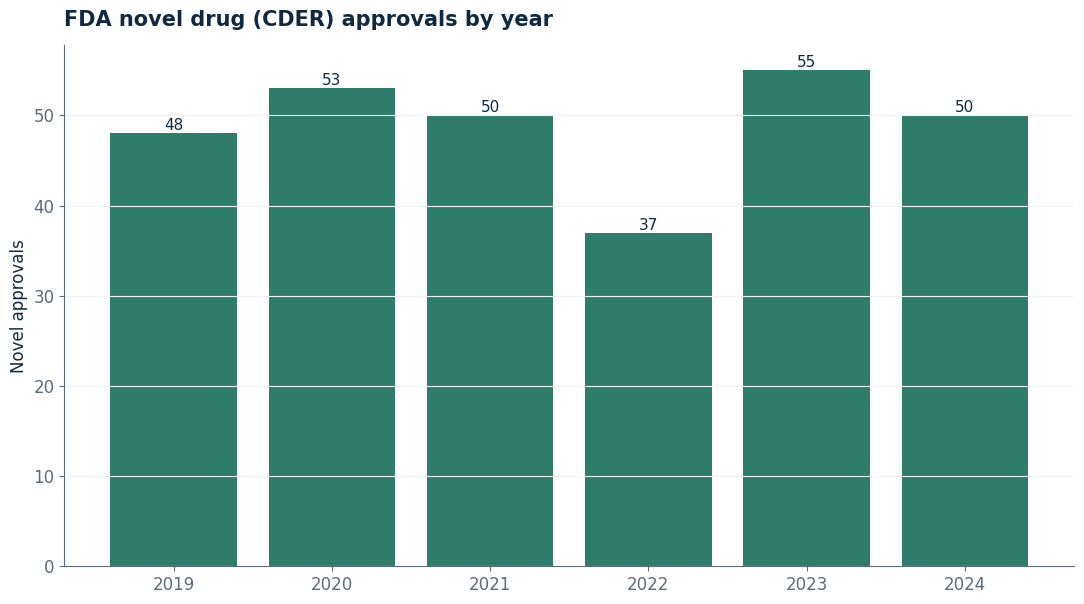
Look at that chart and the message is encouraging: the FDA’s novel-drug approvals have stayed strong over time, with the agency clearing dozens of genuinely new medicines in a typical year. That steady output is the raw material of every revenue forecast in pharma and biotech — no approvals, no growth. It’s also why I pay attention to the regulatory environment as a top-down signal, not just to individual company news. A productive FDA is a tailwind for the entire sector; a slowdown would be a warning for all of it.
The flip side of all this innovation is that it’s expensive to value. Pricing a company on drugs that don’t exist yet, or barely do, is the central challenge of healthcare investing, and the usual price-to-earnings shortcuts fall apart fast. I lean hard on a proper framework here, and the principles in my guide to how to value growth stocks apply directly — especially the discipline of refusing to pay any price just because the science is dazzling.
Healthcare REITs: the landlord’s angle on aging
Here’s a corner of healthcare a lot of growth investors overlook, and I think that’s a mistake. You don’t have to own a drugmaker or a device company to ride the aging-population trend — you can own the real estate that medicine runs on. Healthcare real estate investment trusts hold senior housing, medical office buildings, hospitals, and skilled-nursing facilities, and the same demographic wave that lifts pharma fills those buildings with tenants and residents.
Names like Welltower (WELL) and Ventas (VTR) let you play the trend with the income characteristics of a REIT, which is a different risk-and-reward shape than a clinical-stage biotech entirely. It’s steadier, it pays you regularly, and it’s driven by occupancy and demographics rather than trial outcomes. My honest framing: this is more of an income-with-a-tailwind idea than a high-octane growth play, and I treat it that way.
The two risks I keep front of mind are interest rates — REITs are sensitive to them, and rising rates pressure both their financing costs and their valuations — and tenant health, since a REIT is only as solid as the operators paying its rent. Used well, a healthcare REIT can add ballast and income to a sleeve that’s otherwise full of volatility. I break down the structure, the rate sensitivity, and the names I’d consider in my guide to healthcare REIT stocks.
How I actually evaluate a healthcare growth stock
Knowing the sub-sectors is half the battle. The other half is judging an individual company, and healthcare makes that uniquely tricky because the same metric means totally different things depending on what you’re holding. Here’s the framework I run through, and it changes by sub-sector.
For profitable names — large pharma, established device makers, cash-generating biotech — I lean on relatively normal tools: durable revenue growth, margins, the strength of the pipeline against patent expirations, and a valuation that doesn’t already assume perfection. For clinical-stage biotech and gene therapy, traditional metrics are nearly useless because there are no earnings to anchor to. There, the work is pipeline valuation — estimating the probability-weighted value of drugs in development — plus a hard look at the cash runway, because a company that runs out of money before its big readout is in real trouble regardless of how good the science is. That specific skill is the one I’d master first, and it’s the subject of my drug pipeline valuation guide.
Then there’s risk, which in healthcare is not optional reading. The binary outcomes are the obvious danger — a single trial or FDA decision can halve a stock — so I size speculative positions small enough that any one of them going to zero won’t sink me. Beyond that, regulatory and pricing risk hangs over the entire sector: governments and insurers ultimately decide what gets paid for and how much, and drug-pricing politics can move whole industries. My approach is to build the sleeve like a barbell — a stable core of profitable pharma, devices, and maybe a REIT, with smaller satellite bets in biotech and gene therapy where the asymmetric upside lives. Get the position sizing right and you can afford to be wrong on the moonshots. Get it wrong and one bad readout undoes years of work.
Frequently asked questions
What are the best healthcare growth stocks right now?
The most durable healthcare growth stocks tend to be the profitable leaders that ride strong secular trends — Eli Lilly and Novo Nordisk in the GLP-1 boom, Intuitive Surgical in surgical robotics, and diversified pharma like Merck or AbbVie for steadier growth with income. Around that core, biotech and gene-therapy names add higher-risk upside. As always, the “best” pick depends on the price you pay, not just the company.
Are healthcare growth stocks risky?
It depends entirely on the sub-sector. Clinical-stage biotech and gene therapy are among the riskiest investments anywhere — a single trial result can make or break the stock. Large pharma, established medical devices, and healthcare REITs are far steadier and even somewhat defensive. That’s why I build a healthcare sleeve as a barbell: a stable core plus small, carefully sized speculative satellites.
Why are GLP-1 stocks growing so fast?
GLP-1 drugs treat obesity and diabetes, and the untreated patient pool is enormous — billions of people worldwide are overweight or obese while only a small fraction are currently medicated. As insurance coverage expands and convenient oral versions arrive, the addressable market could grow dramatically. Eli Lilly and Novo Nordisk dominate today, though expectations are already high and competition is intensifying. Check current figures before investing.
How do I value a biotech with no profits?
You can’t use a normal price-to-earnings ratio, because there are no earnings. Instead you value the pipeline — estimating each drug candidate’s market size and multiplying by a realistic probability of approval — and you scrutinize the cash runway to be sure the company can fund itself to its next major catalyst. It’s inexact and assumption-heavy, which is exactly why position sizing matters so much here.
Should I buy individual healthcare stocks or a fund?
Both have a place. A healthcare or biotech fund gives instant diversification across the binary outcomes, which genuinely matters in a sector where single stocks can crater on one trial. Individual names offer more upside in exchange for real research and higher single-stock risk. I run a core-and-satellite structure: a diversified base, with researched individual names around it where I have genuine conviction.
The Bottom Line
The best healthcare growth stocks give you something rare — explosive innovation sitting on top of recession-resistant demand and a demographic tailwind you can practically set your watch by. But the sector demands respect, because the same place that hides life-changing winners hides binary blowups that can take a position to zero overnight. My approach after years of getting it both right and wrong is a barbell: a stable core of profitable pharma, established medical devices, and maybe a healthcare REIT for income, surrounded by smaller, carefully sized satellite bets in biotech, GLP-1, and gene therapy where the asymmetric upside lives. Master pipeline valuation, respect the FDA calendar, size your speculative positions so no single trial can sink you, and pair the whole thing with disciplined risk management. Do that, and healthcare stops being the boring sleeve of your portfolio and becomes one of its most powerful growth engines — which is exactly the reversal it pulled off in mine.
The complete healthcare and biotech growth series
Each part of the healthcare and biotech market below has its own deep dive. Together they cover the full range of ways to get growth exposure in this sector.
- AI Healthcare Stocks
- Best Biotech Stocks to Buy
- Biotech IPO Stocks
- Clinical Trial Stocks
- Digital Health Stocks
- Drug Pipeline Valuation
- Gene Therapy Stocks
- GLP-1 Stocks
- Healthcare REIT Stocks
- Best Medical Device Stocks
- mRNA Technology Stocks
- Personalized Medicine Stocks
- Best Pharmaceutical Stocks to Buy
- Telehealth Stocks
For how this sector sits against the others, small cap growth covers the early-stage biotech end, clean energy is the other sector where a long-dated thesis has to survive a policy cycle, and risk management deals with the binary events this sector specialises in.
Last updated: June 2026. Figures are approximate and change — confirm current data before investing. Educational only, not individual investment advice.