On this page
- Why clean energy is a real growth theme and not just a slogan
- The best clean energy growth stocks by sub-sector: a map
- Solar: the cheapest new power on earth, and the most cutthroat
- Wind: big, capital-heavy, and at the mercy of rates
- Electric vehicles: the loudest trade in clean energy
- Batteries and energy storage: the bottleneck everything depends on
- Hydrogen and fuel cells: the highest-risk corner of the sector
- EV charging: a great theme that’s been a tough business
- The real risks of clean energy investing
- How clean energy fits a broader growth portfolio
- Frequently asked questions
- The Bottom Line
- The complete clean energy and EV series
I’ll start with a confession: clean energy has cost me money. Years ago I bought into the first big solar wave convinced I was early to an obvious trend, and I watched a chunk of that position get cut in half when subsidies shifted and cheap capital dried up. So I come to this sector with scars, and I think that makes me a more useful guide than the bulls who only ever show you the upside. Here’s the honest short version. The best clean energy growth stocks live in a handful of sub-sectors — solar, wind, electric vehicles, batteries and energy storage, hydrogen and fuel cells, and EV charging — where falling costs and structural electrification demand can drive years of revenue growth. The catch is that this is one of the most policy-sensitive, boom-bust corners of the whole market, and knowing which slice you’re buying matters more here than almost anywhere else.

This is a sprawling theme, and “clean energy stock” tells you almost nothing on its own. A utility-scale solar developer, an EV maker, a lithium battery supplier, and a tiny hydrogen pre-revenue startup are all “clean energy,” yet they behave like completely different animals — different margins, different risks, different reasons they’d go to zero. So I’m going to break it down the way I actually think about it, sub-sector by sub-sector, and point you to a deeper guide for each one as we go. My goal is that by the end you can look at any clean energy name and roughly place it: what drives it, what could break it, and whether it earns a spot in a growth portfolio.
Why clean energy is a real growth theme and not just a slogan
Let me make the bull case before I spend the rest of the article hedging it, because the bull case is genuinely strong. The energy transition is one of the largest reallocations of capital in modern history. Trillions of dollars are shifting away from fossil fuels toward electrified transport, renewable generation, storage, and the grid that ties it together. That’s not a quarterly product cycle. It’s a multi-decade rebuild of how the world produces and consumes energy, and rebuilds like that throw off durable double-digit revenue growth for the companies positioned right.
Three forces sit underneath the theme. The first is falling cost curves. Solar, wind, and battery costs have dropped dramatically over the past decade or so. Once a clean technology gets cheaper than its fossil alternative without a subsidy, adoption stops being about idealism and starts being about plain economics — and that tipping point has already passed for utility-scale solar and onshore wind in a lot of markets.
The second is electrification of everything. Cars, buses, heating, industrial heat — uses that once ran on liquid fuel and gas are steadily moving to the grid. Every electrified end-use adds permanent demand. This is why the sub-sectors reinforce each other: more EVs means more batteries, more charging, more grid capacity, more clean generation. They pull each other along.
The third is policy and capital tailwinds — and this one is a double-edged sword I’ll come back to hard later. Government incentives, corporate net-zero commitments, and big institutional money have poured into the sector. That support is real and it has built genuine companies. It has also, at times, inflated genuine bubbles. Hold both ideas at once: durable demand does not mean any given stock is a good buy at any given price. That tension is most of the job.
The best clean energy growth stocks by sub-sector: a map
Before we go deep, here’s the map I keep in my head. This table lays out the major sub-sectors, what actually drives each one, a few well-known names so you can anchor it, and the kind of risk that tends to bite. Treat it as a starting frame, not gospel — the lines blur, and plenty of companies straddle two or three of these rows.
| Sub-sector | What drives it | Representative names | Main risk to watch |
|---|---|---|---|
| Solar | Falling panel costs, utility and rooftop demand, electrification | First Solar (FSLR), Enphase (ENPH), SolarEdge (SEDG) | Brutal price competition, policy and rate sensitivity |
| Wind | Offshore and onshore buildout, turbine scale, grid expansion | NextEra Energy (NEE), GE Vernova (GEV), Vestas (VWDRY) | Project cost overruns, interest-rate drag |
| Electric vehicles | EV adoption curve, falling battery prices, model expansion | Tesla (TSLA), BYD (BYDDY), Rivian (RIVN) | Margin wars, demand wobble, fierce competition |
| Batteries & storage | EV demand, grid storage, materials supply chain | Tesla (TSLA), QuantumScape (QS), Albemarle (ALB) | Commodity price swings, China oversupply |
| Hydrogen & fuel cells | Industrial decarbonization, heavy transport, long-term bets | Plug Power (PLUG), Bloom Energy (BE), Ballard (BLDP) | Mostly pre-profit, cash burn, unproven economics |
| EV charging | Growth of the EV fleet, public and home charging buildout | ChargePoint (CHPT), EVgo (EVGO), Tesla (TSLA) | Thin margins, slow utilization, heavy capital needs |
Notice that a few names show up in several rows. Tesla is an EV maker, a battery and storage company, and a charging network all at once — which is exactly why it’s been so hard to categorize and so volatile to own. NextEra straddles wind, solar, and the regulated utility world. That overlap isn’t a quirk; it’s the structure of the sector. Now let’s take the sub-sectors one at a time.
Solar: the cheapest new power on earth, and the most cutthroat
Solar is the sub-sector that best captures the whole clean energy story — the spectacular promise and the painful reality, side by side. The promise is simple and real: in much of the world, utility-scale solar is now the cheapest source of new electricity ever built, full stop. When a technology wins on raw cost, you don’t have to believe in anything except arithmetic for it to keep taking share.
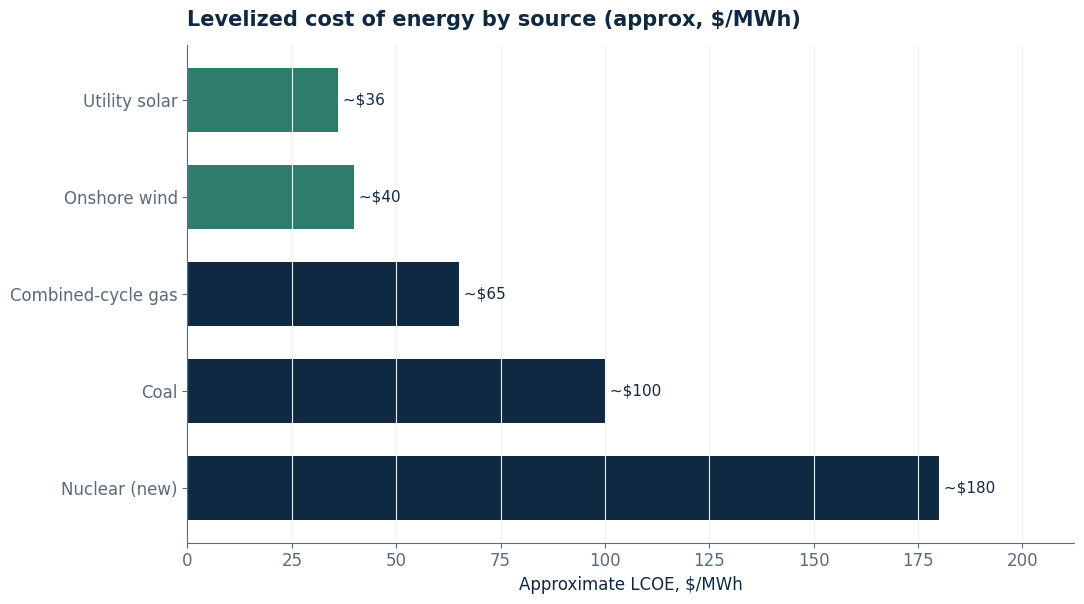
Look at where solar and wind sit on that chart relative to the fossil options. That gap is the entire bull case in one picture. The levelized cost of energy — basically the all-in cost to produce a unit of electricity over a project’s life — has collapsed for renewables as panels got cheaper and projects got bigger. Once you’re the low-cost producer, growth follows the math, not the politics.
So why has solar burned so many investors? Because being the cheapest power source and being a profitable manufacturer are two very different things. Panel making is a commoditized, low-margin grind where Chinese oversupply has repeatedly crushed prices and wiped out weaker players. The companies I pay most attention to are the ones with a real edge — a differentiated technology, a strong U.S. manufacturing footprint, or a position higher up the value chain in inverters and software rather than raw panels. First Solar (FSLR) with its distinct thin-film tech, and the residential names like Enphase (ENPH) and SolarEdge (SEDG) that sell the brains of a rooftop system, sit in different competitive spots than a generic module supplier, and that difference shows up in the financials. I dig into the specific companies, the tiers within the industry, and how I separate survivors from value traps in my full guide to the best solar stocks to buy.
My honest take on solar: the secular trend is about as solid as anything in clean energy, but the sub-sector is rate-sensitive and ferociously competitive, so position size and price discipline matter enormously. Residential solar in particular lives and dies by interest rates, because most homeowners finance their systems — when borrowing gets expensive, demand falls off a cliff. Own it, but own it knowing the ride is rough.
Wind: big, capital-heavy, and at the mercy of rates
Wind shares solar’s headline virtue — it’s one of the cheapest new sources of generation — but it’s a fundamentally different business to own. Wind projects are enormous, capital-intensive, long-lead undertakings, and that financial profile defines both the opportunity and the risk. Onshore wind is mature and economic in many regions. Offshore wind is the bigger growth frontier and also the messier one, where I’ve watched developers eat painful cost overruns and cancel projects when economics flipped against them.
The single biggest swing factor in wind is interest rates, and I want to be blunt about why. A wind farm is a huge upfront capital outlay that pays back slowly over decades. When rates are low, that math is wonderful. When rates rise, the financing cost balloons and projects that pencilled out beautifully suddenly don’t — which is exactly what hammered the offshore wind names in the recent rate-hiking cycle. If you can’t stomach a holding whose fortunes hinge partly on the bond market, wind may not be your sub-sector.
The names worth knowing split into a few roles. There are the turbine manufacturers, like GE Vernova (GEV) and the European pure-plays such as Vestas (VWDRY), who build and service the machines. There are the developers and operators — and here the standout is NextEra Energy (NEE), which has built one of the largest renewable generation fleets in the world while sitting inside a regulated utility, giving it a steadier profile than a pure-play. I lay out the manufacturers, the developers, and how to read the offshore-versus-onshore split in my guide to the best wind energy stocks.
My take: wind is a real long-term theme, but it’s the sub-sector where I most insist on quality balance sheets and operators who’ve proven they can deliver projects on budget. The cost-overrun risk here is not theoretical — it has destroyed real money in recent years.
Electric vehicles: the loudest trade in clean energy
EVs are the most visible, most hyped, and most argued-about part of this entire sector, and for good reason — they sit at the center of the whole electrification thesis. The long arc is hard to dispute: the world is shifting from internal combustion to electric drivetrains, battery costs keep falling, and the model lineup expands every year. That’s a structural growth story measured in decades.
But owning EV stocks has taught a lot of investors a humbling lesson, and it’s worth stating plainly. Making cars is a brutal, capital-hungry, low-margin business even when you’re good at it. The early EV winners enjoyed a window of fat margins and little competition; that window has narrowed as legacy automakers and a wave of Chinese manufacturers piled in, touching off price wars that have squeezed everyone. Tesla (TSLA) remains the bellwether and the most profitable Western pure-play, but even it has seen margins compress under competitive pressure. The Chinese champions like BYD (BYDDY) have scaled with startling speed. And the newer Western entrants such as Rivian (RIVN) face the oldest challenge in autos — surviving long enough to reach the volume where the economics finally work.
Here’s how I frame the EV trade. There’s a world of difference between a profitable, scaled manufacturer and a cash-burning startup betting it can cross the chasm to mass production before the money runs out. The former is a growth investment; the latter is closer to a venture bet, and should be sized accordingly. I separate the survivors from the speculations, and walk through the makers, the suppliers, and the demand signals I actually watch, in my full guide to the best electric vehicle stocks.
One more thing I keep front of mind: EV demand has not been the smooth straight line the early bulls promised. It comes in waves, it’s sensitive to incentives and charging anxiety, and a soft quarter can crater these stocks. Buy the long thesis if you believe it, but don’t mistake the long thesis for a quiet ride.
Batteries and energy storage: the bottleneck everything depends on
If I had to pick the single most strategically important sub-sector in clean energy, it might be this one — because batteries are the chokepoint that the EV story and the grid-storage story both run through. You can’t electrify transport without cheaper, better batteries, and you can’t make intermittent solar and wind reliable without storage to shift power from when it’s generated to when it’s needed. Demand pulls from two enormous directions at once.
The sub-sector spans several layers, and they don’t behave alike. At the top are the cell and pack makers, including Tesla (TSLA) with its in-house battery effort and the big Asian manufacturers who dominate global production. Below them sit the materials and mining companies — the lithium, nickel, and processing players like Albemarle (ALB) — whose fortunes ride the commodity cycle and can swing violently with the price of the underlying metals. And then there are the next-generation technology bets, the solid-state and advanced-chemistry hopefuls like QuantumScape (QS), which are largely pre-revenue moonshots: huge upside if the technology works and scales, a real chance of going nowhere if it doesn’t.
I want to flag the commodity exposure loudly, because it trips people up. A lithium miner is not a software company — it’s a cyclical resource business, and when battery-metal prices crashed amid a glut of Chinese supply, those stocks fell hard regardless of how strong the long-term demand story was. Storage as a theme can be excellent while individual materials stocks are getting wrecked by the cycle. I break down the layers, the chemistry shifts worth understanding, and how I think about owning storage exposure in my guide to the best battery stocks.
My honest assessment: batteries and storage are central to the entire transition and I want exposure, but I treat the materials names as cyclicals and the next-gen technology names as speculative — never as steady compounders. Position them as what they actually are.
Hydrogen and fuel cells: the highest-risk corner of the sector
Now we get to the part of clean energy where I urge the most caution, and I say that as someone who finds the technology genuinely fascinating. Hydrogen has a real role to play in decarbonizing the things batteries struggle with — heavy industry, steel, long-haul transport, certain kinds of grid backup. The long-term vision is legitimate. The near-term investment reality is brutal.
Here’s the uncomfortable truth about most pure-play hydrogen and fuel cell stocks: they are largely pre-profit, they burn cash at a meaningful clip, and the economics of green hydrogen still depend heavily on subsidies and on technology costs coming down further than they have so far. Names like Plug Power (PLUG), Bloom Energy (BE), and Ballard Power (BLDP) have been around the hype cycle more than once, soaring on policy announcements and then giving it all back when the timeline to actual profitability stretched out. I’ve seen this movie, and the ending has usually been hard on shareholders who bought the story at the peak.
That doesn’t mean avoid the sub-sector entirely — it means understand exactly what you’re buying. A hydrogen pure-play is a long-dated option on a technology and a policy environment, not a steady growth business. It belongs, if at all, as a small, speculative slice of a portfolio, sized so that a total loss wouldn’t hurt much, because for some of these names that outcome is genuinely on the table. I walk through the different business models, the green-versus-blue hydrogen distinction, and the handful of names with more credible paths in my guide to hydrogen fuel cell stocks.
My bottom line on hydrogen: respect the long-term potential, distrust the near-term hype, and never let a hydrogen position grow into a size that can do real damage. This is the sub-sector that has burned the most investors who confused an exciting story with a sound investment.
EV charging: a great theme that’s been a tough business
EV charging is a perfect example of why a brilliant macro thesis doesn’t automatically make a good stock — and it’s a lesson I wish more growth investors internalized. The thesis is airtight: as the EV fleet grows, it needs somewhere to charge, and that means a massive buildout of public, workplace, and home charging infrastructure. More EVs, more charging. The demand arrow only points up.
And yet the pure-play charging companies have been some of the most disappointing stocks in all of clean energy. Why? The economics are genuinely hard. Building and maintaining charging hardware is capital-intensive, utilization has often been lower than projected because the EV fleet is still scaling, and the margins on selling electricity are thin. Several high-profile charging names, including ChargePoint (CHPT) and EVgo (EVGO), came public with enormous expectations and then struggled with cash burn and a long, slow road to profitability. The thesis was right and the stocks still fell — exactly the trap I keep warning about.
There’s also a competitive wrinkle that matters: the most successful charging network so far has been built by an automaker, Tesla (TSLA), as part of a broader ecosystem rather than as a standalone business that has to make money on charging alone. That tells you something about how hard pure-play charging economics are. I get into the network models, the hardware-versus-software split, and which approaches have the best shot at actually turning a profit in my guide to the EV charging stocks.
My take: I love the charging theme and I’m wary of the charging stocks. If you invest here, favor models with a credible path to real margins and a balance sheet that can survive a long ramp, and keep your expectations for the timeline honest.
The real risks of clean energy investing
I’ve sprinkled warnings through every section, but the risks in this sector are systematic enough that they deserve their own honest accounting. If you take nothing else from this article, take this part. Clean energy is not a buy-and-forget theme, and the investors who got hurt almost always underestimated one of these forces.
Policy and subsidy dependence. This is the big one. A meaningful share of clean energy economics still rests on government incentives, tax credits, and mandates. That support has built the industry — but it also means a change in administration, a budget fight, or a tweak to a tax credit can reprice an entire sub-sector overnight. I learned this the hard way: my early solar losses came largely from a subsidy shift I hadn’t priced in. When a company’s profitability depends on a policy that can change with an election, you are taking political risk whether you acknowledge it or not. Acknowledge it.
Interest-rate sensitivity. Clean energy is unusually exposed to rates, more than most investors realize. These are capital-intensive businesses building long-lived assets — solar farms, wind projects, charging networks — that get financed upfront and pay back over decades. Higher rates raise the cost of that financing and crush project returns, and they hit residential solar especially hard because homeowners finance their systems. The rate-hiking cycle of recent years was a wrecking ball for big parts of this sector, and it’s a reminder that the bond market can matter as much as the technology.
Boom-bust cycles and hype. Clean energy runs hot and cold like few other sectors. A wave of optimism — a big policy package, a flood of capital — sends valuations to absurd levels, a flood of companies go public on stories rather than profits, and then reality arrives and the whole group gets cut down together. I’ve watched this cycle play out more than once. The structural trend keeps grinding forward underneath, but the stock prices overshoot wildly in both directions, and a lot of permanent capital gets destroyed in the busts by people who bought at the top.
Commodity and supply-chain exposure. Batteries, solar panels, and wind turbines all depend on raw materials and global supply chains — lithium, polysilicon, rare earths, steel — much of it concentrated in a few countries, especially China. That creates price volatility and geopolitical risk that can swamp a company’s own operational progress, as the battery-metals crash showed.
The way I manage all of this is straightforward, and it’s the same discipline I apply to every volatile growth theme. I diversify across sub-sectors so a single policy shift can’t sink the whole position. I favor companies with real balance-sheet strength that can survive a downturn rather than story stocks living on the next capital raise. I size speculative names — hydrogen, next-gen batteries, pure-play charging — small enough that a total loss is survivable. And I size the whole clean energy sleeve as one slice of a broader portfolio, not the whole thing. If you want the full framework I use to control downside in high-volatility growth investing, I lay it out in my guide to risk management for growth stock investors. This is the sector where that discipline earns its keep.
How clean energy fits a broader growth portfolio
I don’t think anyone should build a portfolio that’s only clean energy — the volatility is too punishing and the policy risk too concentrated. I think of it as one high-conviction, higher-risk theme that sits alongside steadier growth exposure. Clean energy and technology overlap more than people expect, too: the software, semiconductors, and AI running modern grids, EVs, and energy management are part of the same electrified future, and a lot of the best operators are as much tech companies as energy companies. If you want to see where the two themes meet, my guide to the best technology growth stocks is a natural companion to this one.
For most people, a sensible approach is to pair the durable winners in this sector — the cost-advantaged solar leaders, the quality wind operators, the profitable scaled EV and battery names — with a core of broader growth holdings, and to keep the speculative clean energy bets to a small, deliberate slice. If you’re assembling a watchlist for the year ahead and want to see how clean energy names stack up against the broader field, I keep a running view in my roundup of the best growth stocks to buy in 2026. Clean energy deserves a seat at that table — it just shouldn’t be the whole table.
Frequently asked questions
Are clean energy stocks a good investment in 2026?
They can be, with eyes open. The long-term electrification trend is durable and the cost advantages of solar and wind are real. But the sector is volatile, policy-sensitive, and prone to boom-bust swings, so it suits investors who can tolerate big drawdowns and size positions carefully. I treat it as one higher-risk slice of a diversified growth portfolio, not a core holding.
Which clean energy sub-sector is the safest for a new investor?
“Safe” is relative here, but I’d point newer investors toward the cost-advantaged, profitable end — established solar leaders or diversified renewable operators with regulated-utility ballast tend to be steadier than pre-revenue hydrogen names or pure-play charging startups. Avoid building your first position around cash-burning story stocks, however exciting the pitch. Profitability and a strong balance sheet matter more than narrative.
Why have so many clean energy stocks lost money?
Mostly three reasons. Subsidy and policy shifts repriced whole sub-sectors. Rising interest rates crushed these capital-heavy, long-payback businesses. And hype cycles pushed valuations to levels reality couldn’t support, especially for unprofitable companies that went public on a story. The underlying trend kept advancing, but the stocks overshot in both directions and many buyers got caught at the top.
Is it better to buy individual clean energy stocks or a fund?
It depends on your time and risk tolerance. A diversified fund spreads single-company blowup risk across the whole theme, which matters a lot in a sector this volatile and where individual names genuinely go to zero. Picking individual stocks offers more upside if you do the work, but it demands real research into balance sheets and competitive position. Many investors sensibly use a mix.
How much of my portfolio should be in clean energy?
That’s personal and not advice, but I’ll share my own thinking: I treat clean energy as one thematic sleeve among several, not a dominant allocation, precisely because of the policy and rate risk. Within that sleeve I keep the speculative names small enough that a total loss is survivable. The goal is exposure to a powerful long-term trend without betting the portfolio on it.
The Bottom Line
Clean energy is, in my honest opinion, one of the most genuinely exciting long-term growth themes available — and one of the most dangerous places to invest carelessly. The electrification of the world is real, the cost curves are real, and the demand is durable. But the sector has burned a lot of investors who confused a great thesis with a great stock, ignored the policy and rate risk, or bought the hype at the top of a cycle. The best clean energy growth stocks reward patience, diversification across sub-sectors, a strong preference for quality balance sheets, and the discipline to keep the speculative bets small. Respect the volatility, do the work on each name, and treat this as one part of a broader portfolio rather than the whole bet.
The complete clean energy and EV series
Each corner of the clean energy and EV market gets its own full breakdown below.
- Best Battery Stocks
- Carbon Capture Stocks
- Electric Bus Stocks
- Best Electric Vehicle Stocks
- Energy Storage Stocks
- EV Charging Stocks
- EV Supply Chain Stocks
- Grid Modernization Stocks
- Hydrogen Fuel Cell Stocks
- Best Nuclear Energy Stocks
- Best Solar Stocks to Buy
- Sustainable Investing Stocks
- Best Wind Energy Stocks
This sector leans on the rest of the site more than most: valuation discipline matters because so much of the value sits in the terminal year, portfolio strategy decides how much of a volatile theme you should own, and the screening process is how you separate the operators from the announcements.
Last updated: June 2026. Figures are approximate and change — confirm current data before investing. Educational only, not individual investment advice.